Residential tariffs
Find the tariff that works best for your home – choosing the right energy plan could help you save.
Find the right tariff in minutes
Instantly see which tariff could lower your energy bills.
Log in or register for My Account to compare tariffs based on your energy use. On the Dashboard, go to the Better Offer tile and select ‘Compare Tariffs’.
Heads up, you’ll need a smart meter with 12 months of your usage to compare your tariff options in My Account. Don’t have a smart meter yet? Request one online.
How residential tariffs work
A tariff is how we calculate your electricity bill. Watch this short video to hear from Skye, one of our local energy experts from Rockhampton, who explains how tariffs work and how choosing the right one can help you save.
Transcript
Hi, I’m Skye from Ergon Energy Retail here in Rockhampton. And today we’re going to be making your electricity tariffs easy to understand. Let’s break down your tariff options so you can understand what might work best for your household.
First up, let’s talk about primary tariffs. Every home has one. A primary tariff supplies electricity to the majority of the appliances in your home, whether that’s a fridge, your fans, your power points and lights. They power all of the essentials.
You have three choices for your primary tariffs. These are flat rate, time of use and demand.
First of all, we’ve got flat rate tariffs. This one’s super simple. You pay the same flat rate per kilowatt hour all day, no matter what time of the day it is. Plus a daily service fee. Go Queensland! Woooo!
Another option is time of use tariffs. These rates change depending on when you use your power. Daytime, between 11am to 4pm is the cheapest. The peak is between 4pm to 9pm and that’s the most expensive. All other times are mid-range prices. There’s also a daily service fee.
If you’re home during the day and can shift things like doing the laundry, dishwashing, air-conditioning or other larger appliances to daytime, a time of use tariff could be for you.
And then we have demand tariffs. With these tariffs, the rates you’re charged change throughout the day depending on when you use your power.
There is a demand charge based on your highest half hour of use during 4pm to 9pm each month. So a demand tariff is great if you use power during the day or overnight, and can avoid using a lot of power at once during the 4pm to 9pm peak. There is also a daily service fee.
So those are all the primary tariffs options. Now let’s talk about secondary tariffs, also known as economy tariffs. These are perfect for appliances that don’t need a constant electricity supply. Like hot water systems, pool pumps or even EV chargers.
Because supply can be interrupted, usage rates are cheaper on an economy tariff. To switch to an economy tariff, you’ll need the help of a licensed electrician.
Not sure which tariff is right for you? That’s ok, we’re here to make it easy. Our free tariff comparison tool takes the guesswork out of it, and helps you find the best fit for your household in just a few clicks. You can see savings on your energy bills, without changing how or when you use your power.
If you’ve got a smart meter, learn how you can compare your tariffs easily online at ergon.com.au/compare
Dive deeper and explore your tariff options today by logging in or registering for My Account at ergon.com.au/myaccount
We’re Ergon Energy Retail, your local energy experts.
Primary tariffs - Power for your whole home
Primary tariffs keep your appliances running 24/7.
Rates from 1 July 2026. All prices include GST. See Basic Plan Information for more details.
Current rates from 1 July 2026
| Tariff | Tariff type | Great for... | Usage rates | Service fee |
|---|---|---|---|---|
| 11 | Flat rate | Households that use most power during the 4–9pm peak. | All day $0.28895/kWh | $1.80508/day |
| 12D | Time of use | Daytime users and those who can use less power during the 4–9pm peak. Smart meter required. | Day Peak Night | $1.56730/day |
| Solar Soaker (12E) | Time of use | Households home during the day. No solar needed. Smart meter required. Learn more in our Solar Soaker video. | Day Peak Night | $1.56730/day |
| Solar Sharer (12F) | Time of use | Households home during the day and can shift usage from the peak period. No solar needed.Smart meter required. | Solar Sharer period Solar Sharer period Day Peak Night | $1.77853/day |
| 14C | Time of use demand | Households that can avoid running big appliances in the same half hour block between 4–9pm. This tariff offers cheaper usage rates throughout the day - even peak hours. Smart meter required. Additional demand charge Peak demand charge - $0.26661/kW per day | Day Peak $0.20945/kWh Night | $1.35114/day |
Demand charging explained
What’s demand charging?
In short: Demand charging is about how much electricity is used at the same time.
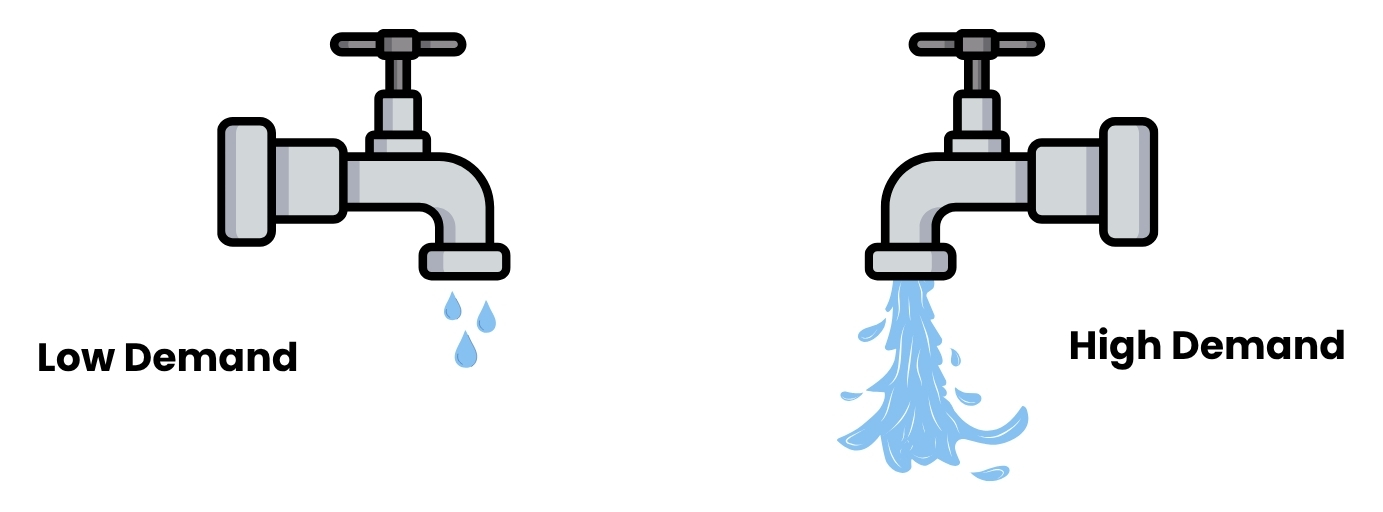
Think of it like filling a bucket with water:
- Turn the tap halfway and fill it slowly - that's low demand
- Crank the tap full blast and fill it fast - that’s high demand.
Electricity works the same way. A few small appliances? Low demand. But fire up the air con, oven, and a few big machines all at once? Your demand shoots up.
The more power that’s used at once, the higher the demand.
How is demand calculated?
We look at the 30-minute window between 4pm and 9pm on any day in the month when you used the most electricity. That’s your peak moment.
Here’s how we work it out:
- Convert the peak to kilowatts: We take your highest 30-minute usage in kilowatt-hours, then double it to get kilowatts (kW). Why double? Because we’re converting half an hour into an hourly measure.
- Apply the demand rate: Then we multiply that by the daily rate ($/kW/day) and the number of days in your billing period.
This helps cover the cost of keeping the network ready when demand is at its highest - so everyone stays powered up when it matters most.
Compare with rates from 1 July 2025
Previous rates from 1 July 2025
All prices include GST.
| Tariff | Tariff type | Great for... | Usage rates | Service fee |
|---|---|---|---|---|
| 11 | Flat rate | Households that use most power during the 4–9pm peak. | All day $0.32973/kWh | $1.68842/day |
| 12D | Time of use | Daytime users and those who can use less power during the 4–9pm peak. Smart meter required. | Off-peak Night Peak | $1.48834/day |
| Solar Soaker (12E) | Time of use | Households home during the day. No solar needed. This tariff offers the cheapest off-peak usage rate! Smart meter required. Learn more in our Solar Soaker video. | Off-peak Night Peak | $1.48834/day |
| 14C | Time of use demand | Households that can avoid running big appliances in the same half hour block between 4–9pm. This tariff offers cheaper usage rates throughout the day - even peak hours. Smart meter required. Additional demand charge Peak demand charge - $0.28041/kW per day | Off-peak Night Peak $0.24984/kWh | $1.26666/day |
Note: Solar Sharer (12F) wasn't available in 2024-25.
Compare your tariffs in My Account
Unlock the benefits of smart meters with our tariff comparison tool in My Account!
Hear from Joel, one of our local Energy Specialists from Rockhampton, as he explains how to compare tariffs in My Account - no guesswork needed.
Transcript
Hi! I’m Joel from Rockhampton and I’m an Energy Specialist here at Ergon Energy Retail.
Do you have a Smart Meter? And are you ready to check you’re on the best tariff for your premises? Our handy Tariff Comparison Tool in My Account has you covered!
Let me show you how easy it is to use your usage data to choose the right tariff - tailor made to suit your needs!
To get started, simply log into My Account. Once you’re in the dashboard, select the tariff comparison tool.
You'll also see an information block which will indicate if you're on the best tariff rate already or if there may be a more cost-effective tariff better suited to how you use your energy.
This information is based off your premises previous energy usage and you will need at least 12 months’ worth of data to be able to use our Tariff Comparison tool.
It’s important to note that this assumes your future usage patterns will remain consistent with how you’ve been using your energy.
Below, you’ll see a list of tariffs, along with projected costs.
It’s also easy to switch tariffs! Simply click on “SWITCH TARRIFS”, and one of our friendly local Energy Specialists will get back to you as soon as possible to explain any conditions, answer questions and confirm the tariff change on your account.
And that’s a wrap on our awesome tariff comparison tool and how it can help you save!
Curious to know more about your household tariffs? Want to compare tariffs to ensure you’re getting the best offer? Dive in and discover more today by logging in or registering for My Account at ergon.com.au/myaccount!
We’re Ergon Energy Retail, your local energy experts.
How to change your primary tariff
Easy guide to changing your primary tariff
There's no cost to change your primary tariff. We'll only change your tariff if you consent.
Had a smart meter for 12 months or more?
Request a tariff change anytime in My Account. On the Dashboard, go to the Better Offer tile and select ‘Compare Tariffs’.
Had a smart meter less than 12 months?
Please call our regional Queensland team on 13 10 46 to request a tariff change.
Have a basic meter?
You’ll first need to upgrade to a smart meter. You can request a smart meter using our online form.
There’s no additional charge for a smart meter, but your switchboard must be compliant. Your electrical contractor can assist in assessing your switchboard.
Not sure what type of meter you have?
You can check your meter type in My Account or on page 2 of your bill.
Economy tariffs - For specific appliances
Economy tariffs are great for appliances like hot water systems, pool pumps and EV chargers that don't need constant power.
They're cheaper because the operating times are controlled by Ergon Energy Network and can change day to day, depending on network demand.
Rates from 1 July 2026. All prices include GST. See Basic Plan Information for more details.
Current rates from 1 July 2026
| Tariff | Power access | Suited to | Usage rates |
|---|---|---|---|
| 31 | At least 8 hours/day (switch off times vary) |
| $0.16663/kWh |
| 33 | At least 16 hours/day (switch off times vary) |
| $0.16764/kWh |
Learn more about the size of hot water systems that can be run on tariffs 31 and 33.
Compare with rates from 1 July 2025
Previous rates from 1 July 2025
All prices include GST.
| Tariff | Power access | Suited to | Usage rates |
|---|---|---|---|
| 31 | At least 8 hours/day (switch off times vary) |
| $0.18118/kWh |
| 33 | At least 16 hours/day (switch off times vary) |
| $0.19135/kWh |
How to change to an economy tariff
You can change to an economy tariff by getting in touch with our regional Queensland team.
To add an economy tariff
- You’ll need to engage a licensed electrician to complete work first
- Once they’ve completed the job and submitted the paperwork, we’ll organise for a crew to attend the property to add the economy tariff
- There’s a one‑off cost of $208.71 inc. GST for standard residential properties, which will be charged via your electricity bill.
Frequently asked questions
How can I run my appliances on an economy tariff?
To connect an appliance to an economy tariff, contact a licensed electrical contractor to discuss your needs and arrange for any work to be completed.
Your electrical contractor will let us know when the changes have been made.
Can I connect an air conditioner to an economy tariff?
Yes, but power may be temporarily switched off during peak demand times (like hot summer evenings) to help manage the network.
Before connecting your air conditioner:
- Consider keeping some AC units on a standard tariff
- Use ceiling or pedestal fans as a backup
- Cool the room earlier in the day, before peak demand (typically 4–9pm).
If you rely on air conditioning for health or comfort, a standard tariff may offer greater peace of mind.
When I'm on an economy tariff, when will power be available?
Ergon Energy Network manages the hours of supply for these tariffs, which may be switched off at any time to manage electricity demand. Each day, Tariff 33 is available for at least 16 hours and Tariff 31 is available for at least 8 hours. Supply times vary and can change daily.